Boiler Pressure Relief Valve Leaking? PRV Causes & Fixes
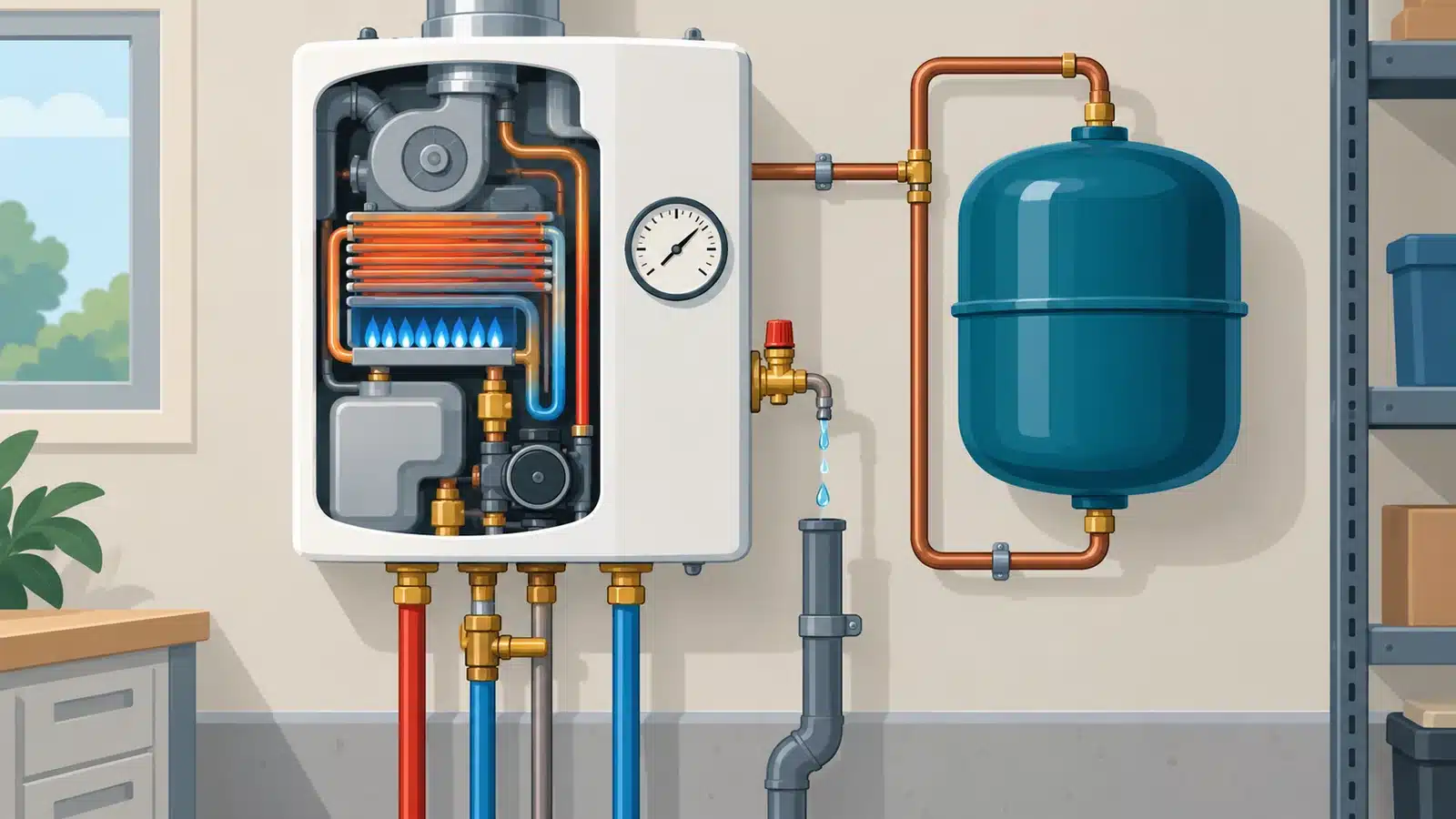
Quick answer: A boiler pressure relief valve leaking means the system pressure is reaching the valve’s setting (often 30 psi on home boilers) or the valve is not sealing. The most common causes are a waterlogged or failed expansion tank, a fill (pressure-reducing) valve letting in too much water, a leaking coil in an indirect water heater, or debris on the relief valve’s seat. Check the boiler’s pressure gauge with the boiler cold and again when hot. Never cap or plug the valve or its pipe, and don’t keep topping up or draining the system yourself: frequent weeping means calling a heating technician.
This page is about hot-water (hydronic) heating boilers. If the dripping valve is on a water heater tank, see water heater pressure relief valve leaking. “PRV” can mean the pressure relief valve (the safety valve, usually with a lever and a pipe pointing down) or the pressure-reducing fill valve that feeds water into the system. Here we say “relief valve” and “fill valve” to keep them apart.
In this guide
Is a boiler pressure relief valve leaking an emergency?
- A drip now and then: not an emergency, but Weil-McLain’s manual says if the relief valve “often weeps,” contact your qualified service technician.
- Steady discharge, or the gauge near the valve’s rating: call a technician the same day.
- Steam or very hot water pouring out, banging or the gauge climbing past the valve’s rating: turn the boiler off at its service switch and call for emergency service. Stay clear of the discharge pipe; it can scald.
Start with the pressure gauge
Most residential boilers have a combined pressure and temperature gauge. Note the pressure when the boiler has been off and is cold, then again at full temperature.
- Normal: pressure rises a little as the water heats. Caleffi suggests a minimum of about 12 psi in the basement for a typical home system, and Weil-McLain’s manual says the reading “does not exceed 24 psig” for its boilers. Your boiler’s manual or label gives its range.
- Pressure jumps sharply when the boiler heats: points to the expansion tank. Weil-McLain says higher pressure “may indicate a problem with the expansion tank or gauge.”
- Pressure high even when cold, and creeping up: water is getting in: a fill valve passing water, or a leaking indirect water heater coil.
- Pressure normal, valve still drips: the relief valve itself is not seating.
Match what you see to the cause
| What you see | Most likely cause | Next step |
|---|---|---|
| Normal when cold, near 30 psi when hot; drips during heating | Expansion tank waterlogged, failed or too small | Expansion tank |
| High even when cold; rises over days | Fill valve letting water by | Fill valve |
| Rises mainly when hot water is used or the indirect tank heats | Leaking coil in an indirect water heater | Indirect coil |
| Gauge normal but valve drips | Debris on the valve seat, or a worn valve | Worn valve |
| Temperature far above normal, valve discharging | Overheating: control or limit problem | Turn the boiler off and call |
1. Expansion tank waterlogged, failed or undersized
Water expands as it heats, and the expansion tank absorbs that extra volume. Caleffi lists “a ruptured diaphragm in the expansion tank” and “an undersized expansion tank” as causes of relief valve discharge. Signs of a failed tank include water coming out of the air valve on the tank and a tank that sounds full of water when tapped. Caleffi says the tank’s air charge should match the system’s cold fill pressure; it has to be checked with the tank isolated from system pressure, so leave it to a technician. Replacement is a technician job too.
2. Fill (pressure-reducing) valve letting in too much water
The fill valve feeds water into the system to keep it at its set pressure. Caleffi lists “debris in the pressure-reducing valve supplying makeup water” as a cause: a valve that does not close fully keeps adding water until the relief valve opens. Signs are cold pressure higher than normal and rising over days. A technician can clean, reset or replace it.
3. Leaking coil in an indirect water heater
If your hot water comes from an indirect tank heated by the boiler, a leak in its internal coil lets higher-pressure house water into the boiler loop, raising boiler pressure until the relief valve lifts. Weil-McLain’s troubleshooting guide describes the check: isolate the indirect tank from the boiler system and “observe the boiler system pressure.” If the pressure stops rising, the coil is leaking. This is a technician’s job, and a leaking coil usually means replacing the indirect tank. Weil-McLain also notes that “insufficient allowance for expansion on the boiler side” can lift the relief valve.
4. Debris on the seat or a worn relief valve
Caleffi lists “leakage from a relief valve due to debris on the valve seat,” and Weil-McLain notes dirt and deposits can build up under the seat. Valves also wear with age. Watts says its relief valves are “designed for emergency safety relief, not as an operating control,” so one that has been opening often may not reseal. A technician tests and replaces it with the correct pressure rating for your boiler, often 30 psi on residential systems; Watts gives 30 psi as the standard setting for its 174A boiler valve.
Avoid working the test lever on an old valve to stop a drip: the lever can disturb debris or a worn seal so the valve leaks worse.
What not to do
- Never cap, plug or tie down the relief valve or its discharge pipe. It is the boiler’s protection against excess pressure.
- Don’t keep draining water to lower the pressure, or keep topping the system up. Repeated fresh water brings in oxygen and minerals that corrode the system, and it hides the real fault.
- Don’t replace the relief valve or expansion tank yourself. Both need the system pressure handled safely and the right rating chosen.
- Keep the discharge pipe clear. Weil-McLain says it must be terminated so as to eliminate the possibility of severe burns.
Use your boiler’s manual and a licensed heating technician for expansion tanks, fill valves and relief valves. Suggest a guide or report a correction.
What a repair usually costs
| Repair | Typical cost | Source |
|---|---|---|
| Average boiler repair | $425 (typical range $190 to $660) | Angi (Sept 2026) |
| Expansion tank, installed | $200 to $550 | Angi (Sept 2026) |
| Expansion tank, installed | $300 to $800 | HomeGuide (2025) |
| Relief valve replacement | $100 to $300 | HomeGuide (2025) |
| Service call-out fee | $75 to $200 | HomeGuide (2025) |
Frequently asked questions
Why is my boiler pressure relief valve dripping?
Usually because pressure is reaching the valve’s setting when the boiler heats, most often from a failed or waterlogged expansion tank or a fill valve letting in too much water. If the pressure gauge is normal, debris on the valve seat or a worn valve is the likely cause.
What should boiler pressure be?
It depends on the building and the boiler. Caleffi suggests about 12 psi minimum for a typical home, and Weil-McLain says its boilers should not exceed 24 psig on the gauge. Follow your boiler’s manual or label.
Can I still use my boiler if the relief valve is leaking?
A small, occasional drip usually does not stop the boiler working safely in the short term, but have a technician find the cause promptly. If the valve is discharging steadily or the gauge is near its rating, turn the boiler off and call.
How much does it cost to replace a boiler pressure relief valve?
HomeGuide puts relief valve replacement at about $100 to $300. If the cause is the expansion tank, Angi lists $200 to $550 installed.
Can a bad expansion tank cause the relief valve to leak?
Yes. It is one of the most common causes. Without a working air cushion, heated water has nowhere to expand and the pressure rises until the relief valve opens.
Related: Water heater relief valve leaking · Expansion tank leaking
Sources: Weil-McLain boiler user’s manual · Weil-McLain indirect water heater troubleshooting guide · Caleffi idronics 32: troubleshooting hydronic systems · Watts 174A boiler relief valve · Angi: boiler repair cost · HomeGuide: expansion tank cost · HomeGuide: boiler service cost.
Updated October 22, 2026. Written and edited by Jordan Hale. General educational guidance; boiler service is for licensed professionals.