Hot Water Smells Like Rotten Eggs? Water Heater Causes and Fixes
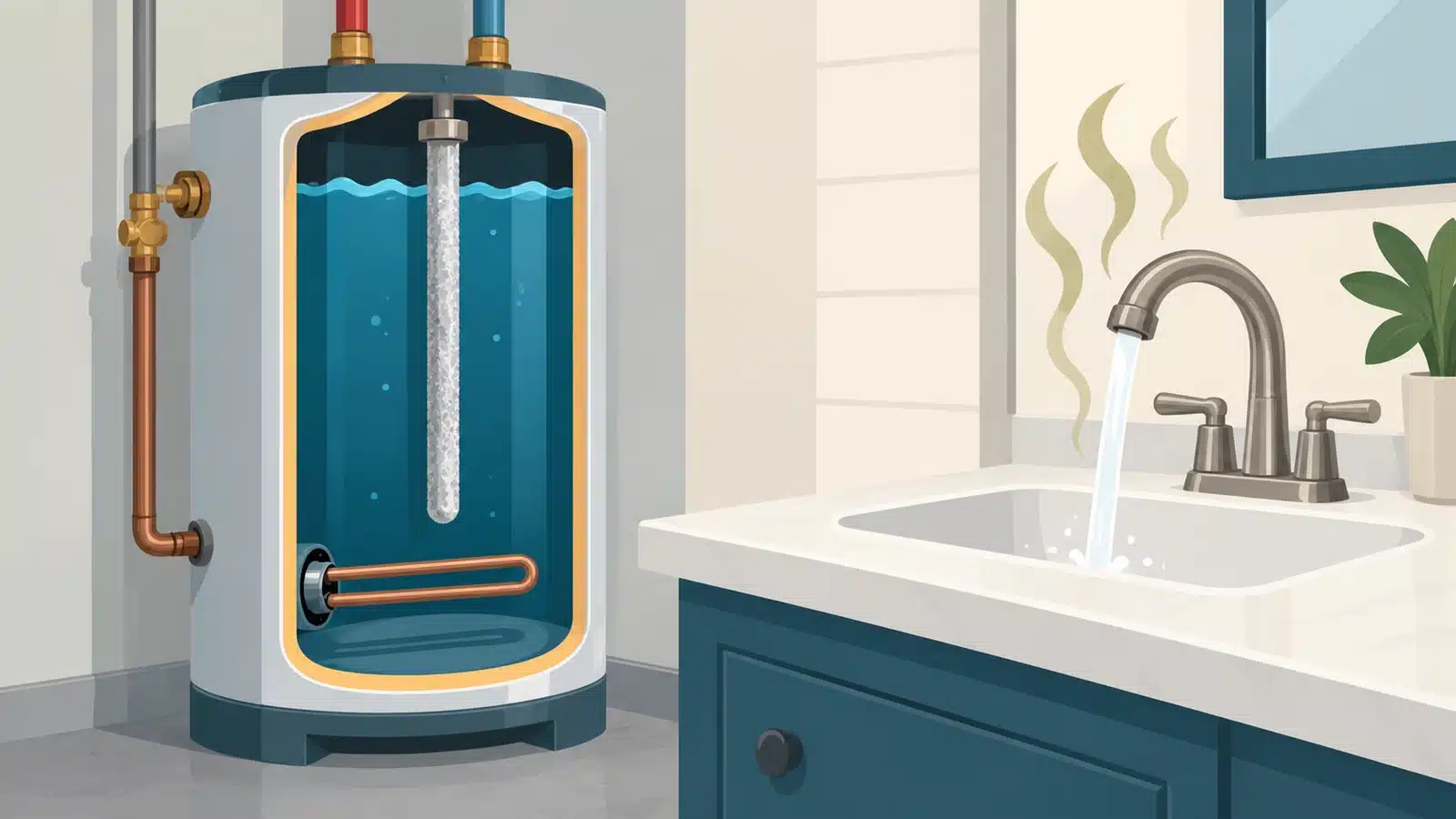
Quick answer: If only the hot water smells like rotten eggs, the water heater is almost always the source. Harmless sulfate-reducing bacteria react with the tank’s magnesium anode rod and make hydrogen sulfide gas. It is a nuisance, not usually a health risk. The fixes are to disinfect the tank with bleach (Rheem’s procedure uses 1 gallon of bleach per 30 gallons of tank) and to replace the anode with an aluminum or zinc one. Never remove the anode altogether: manufacturers say that voids the warranty. If the smell is in the air around a gas water heater rather than in the water, treat it as a gas leak.
Gas or water? Check this first. Utilities add a rotten-egg smell to natural gas and propane so leaks can be noticed. If you smell it in the air near the heater, the gas line or the meter, even with no water running, leave the house now and call your gas utility or 911 from outside. Do not use switches or phones inside. See water heater gas leak. The rest of this guide is for a smell that comes from the water at the tap.
In this guide
Find the source in 5 minutes
The Minnesota Department of Health suggests this test: after the water has not been used for a few hours, smell the water from the hot tap and the cold tap separately. Run some into a glass and smell it away from the sink, so you are not smelling the drain.
| What you find | Where the smell comes from | Next step |
|---|---|---|
| Only the hot water smells | The water heater | Disinfect the tank and change the anode (below) |
| Hot and cold both smell | The water supply, usually a well | Test and treat the water at the source |
| Only one tap smells, and the water in a glass is fine | The drain, not the water | Clean the drain and check the trap holds water |
| Only water that has gone through a softener smells | The softener or the heater | Rheem notes the problem is more common with softened water |
| Smell in the air near a gas heater | Possibly a gas leak | Leave and call the gas utility |
Why the hot water smells like rotten eggs
State, an A. O. Smith brand, lists four conditions that together cause the smell:
- Sulfate in the water.
- Little or no dissolved oxygen.
- Sulfate-reducing bacteria, which are harmless and common in water.
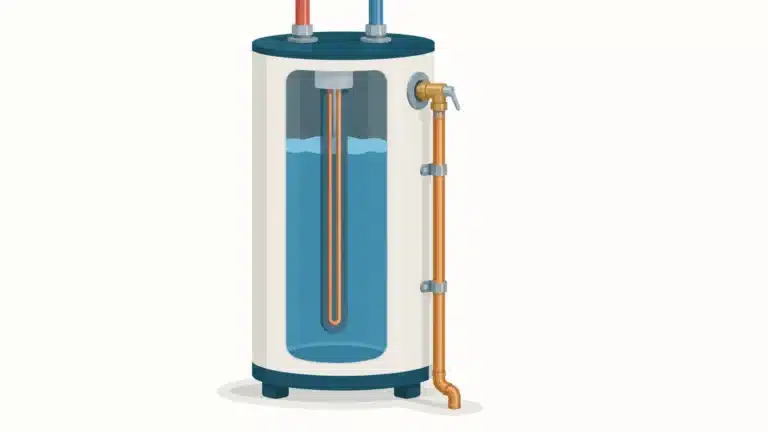
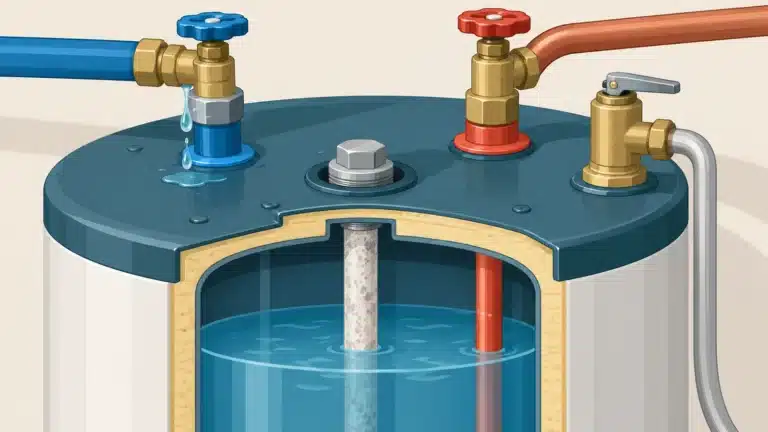
- Extra hydrogen produced by the magnesium anode rod as it protects the tank from rust.
The bacteria use that hydrogen to turn sulfate into hydrogen sulfide, the rotten-egg gas. A warm tank that sits unused, such as after a vacation, or a heater set to a low temperature, gives them ideal conditions. That is why the smell often appears after a trip or after a new softener or a new heater with a fresh magnesium anode.
Is rotten-egg hot water dangerous?
- At the levels found in tap water, usually not. Penn State Extension notes there is no drinking water standard for hydrogen sulfide because it makes water undrinkable “long before it reaches harmful concentrations.” Connecticut’s Department of Public Health says it “does not cause disease.”
- The smell is a nuisance and can be strong: people notice it at very low levels. It can also tarnish silverware and stain fixtures.
- On a well, test anyway. In rare cases, a sulfur smell can come with sewage or other contamination. The Minnesota Department of Health recommends testing a private well for coliform bacteria every year and whenever the water’s taste, smell or appearance changes, and testing for nitrate too.
- Hydrogen sulfide gas can build up in enclosed spaces such as well pits and small well houses, where it can be harmful at high levels. Keep those spaces ventilated.
How to get rid of the smell
| Fix | What it does | Notes |
|---|---|---|
| Disinfect the tank with bleach | Kills the bacteria in the tank and pipes | Rheem’s preferred first step; the smell can return without ongoing treatment |
| Replace the magnesium anode with aluminum or zinc | Cuts the hydrogen the bacteria feed on | A. O. Smith says the anode “can be replaced with a special zinc anode rod” |
| Raise the tank to 140°F for a time | Discourages the bacteria | A. O. Smith and State mention 140°F, with a mixing valve to prevent scalds |
| Treat the water supply | Removes sulfur before it reaches the heater | Needed if the cold water smells too |
| Remove the anode | Not recommended | Voids the warranty and the tank will rust out sooner |
Change the anode rod
Most heaters ship with a magnesium anode. Replacing it with an aluminum or aluminum-zinc anode reduces the hydrogen that feeds the smell. Ask for one approved by your heater’s maker. Connecticut’s Department of Public Health adds that above 150°F only aluminum rods should be used. Anode replacement needs the cold water off, pressure relieved, some water drained and a large socket to break the old rod loose, so many owners have a plumber do it. HomeAdvisor puts anode replacement at $50 to $150 for parts and labor.
Do not just remove the anode. State’s manual says not to leave the tank unprotected, and that doing so voids the warranty. Bradford White says removing an anode, except to inspect or replace it, “will nullify the warranty.” Without an anode, the steel tank corrodes much faster.
Turning up the temperature
Raising the heater to 140°F for a time can help, but water that hot scalds fast: Bradford White warns that scalding can occur within 5 seconds at 140°F. If you raise it, warn everyone in the house, keep the hot taps closed except to flush, and turn it back down afterwards, or have a mixing valve fitted. Some guides suggest 160°F; the Minnesota Department of Health warns that this “can be dangerous,” and it is above what the manufacturers above suggest.
How to disinfect the water heater with bleach
This summarizes Rheem’s technical bulletin for tank water heaters. Follow your own heater’s manual where it differs, and use a plumber if you are not comfortable working on the tank.
- Turn off the power at the breaker (electric) or turn the gas control off (gas).
- Close the cold water valve to the heater.
- Open a nearby hot tap to relieve the pressure, and drain a few gallons to make room for the bleach.
- Add plain household bleach at 1 gallon per 30 gallons of tank capacity. Rheem adds it through the anode rod, relief valve or hot outlet opening, which means removing one of them.
- Refill the tank, then leave the bleach in it for one hour.
- After the hour, open every hot tap in the house to flush the bleach water through the pipes, then drain the tank.
- Refill the tank with fresh water, let it stand 15 minutes, then flush the hot taps and drain it again. Refill and run the hot taps until the bleach smell is gone.
- Check the anode and replace it if it is worn or if the smell came from it.
- Make sure the tank is completely full, with water running from a hot tap, before restoring power or gas. An empty electric tank can burn out its elements.
Rheem notes that disinfecting is fully effective only with ongoing chlorination, so the smell can return within weeks. Changing the anode as well makes a lasting fix more likely.
Tankless and electric heaters
- Electric tank heaters have the same anode and the same fix as gas tank heaters. Make sure the tank is full before the power goes back on.
- Tankless heaters usually have no anode and hold little water, so a rotten-egg smell from a tankless unit usually comes from the water supply. Check the cold water.
Use your heater’s manual or a licensed plumber for anode replacement or tank work, and your local health department for well testing. Suggest a guide or report a correction.
Frequently asked questions
Is it safe to shower in water that smells like rotten eggs?
At the levels usually found in tap water, yes; health agencies describe hydrogen sulfide in water as a nuisance rather than a disease risk. If you are on a well and the smell is new, test the well for coliform bacteria and nitrate to be sure.
Will the rotten egg smell go away on its own?
Sometimes it fades after the water is used regularly again, for example after a vacation. If it keeps coming back, the bacteria and anode are still at work, so disinfect the tank and change the anode.
Can I remove the anode rod to stop the smell?
No. Manufacturers including State and Bradford White say removing the anode voids the warranty, and the tank will corrode much faster without it. Replace it with an aluminum or zinc anode approved for your heater instead.
Why did the smell start after I installed a water softener?
Rheem notes that the problem is more common in softened water, where sodium has replaced calcium and magnesium. Disinfecting the tank and changing to an aluminum or zinc anode is the usual fix; keep the softener itself serviced too.
Why does only my hot water smell?
Because the reaction happens inside the water heater, between the bacteria and the anode rod. If the cold water also smells, the sulfur is in the water supply itself.
Does a powered anode fix rotten egg smell?
Powered anodes protect the tank without the magnesium that feeds the bacteria, and many owners use them for this problem. Check with your heater’s manufacturer about warranty before fitting one.
Related: Water heater gas leak · Flushing out a water heater · Iron in well water
Sources: Rheem: technical bulletin on smelly water · State water heater manual · A. O. Smith water heater manual · Bradford White installation and operating manual · Minnesota Department of Health: hydrogen sulfide in well water · Penn State Extension: hydrogen sulfide · Connecticut DPH: hydrogen sulfide in well water · HomeAdvisor: water heater repair cost.
Updated October 22, 2026. Written and edited by Jordan Hale. General educational guidance; follow your heater’s manual.