Water Softener Not Using Salt or Regenerating? Causes and Fixes
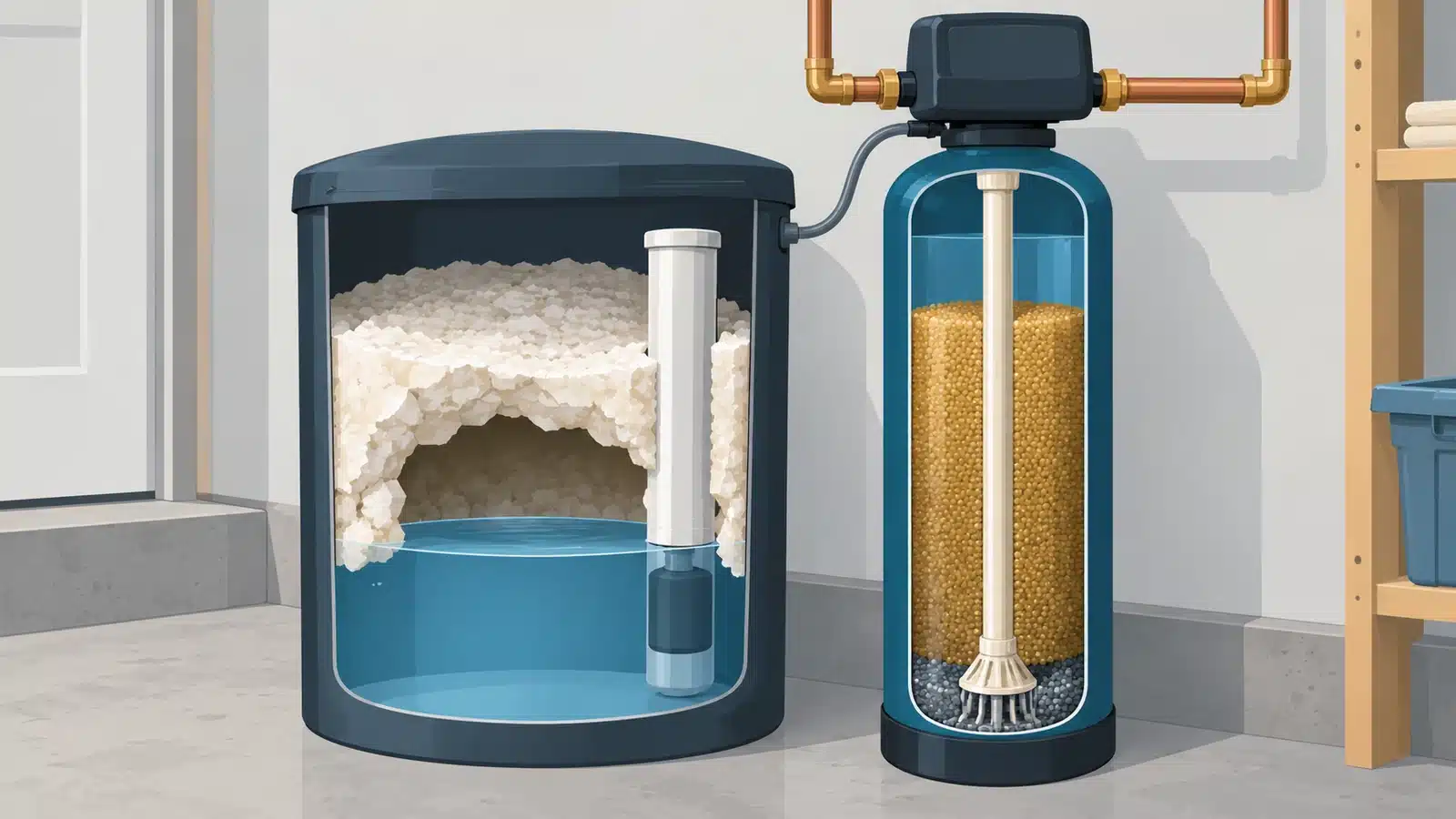
Quick answer: A water softener not using salt is usually not regenerating or not drawing brine. The common causes are a salt bridge (a hard crust over hollow space in the brine tank), the valve left in bypass, a clock that lost its time after a power cut, a plugged injector (venturi) or brine line, or low water pressure. Check those first. Some newer softeners only regenerate when they need to, so a slow drop in salt can be normal; test the water for hardness to be sure.
In this guide
Is it really a problem?
- Demand (metered) softeners regenerate based on how much water you use. GE notes its demand units do “not use much salt.” A small household may go a long time between regenerations.
- Timer softeners regenerate on a set schedule, so salt should drop steadily.
- How to tell: hard-water signs are back (spots on dishes, scale, soap that will not lather), or a hardness test strip shows hardness after a regeneration. If the water is still soft, the softener is probably fine.
Match what you see to the cause
| What you see | Most likely cause | Go to |
|---|---|---|
| Salt level never drops, salt feels solid when pushed | Salt bridge | Cause 1 |
| Sludge or mush at the bottom of the brine tank | Salt mushing | Cause 2 |
| Water is hard and the softener never seems to run | Valve in bypass, or clock or settings wrong | Causes 3 and 4 |
| Brine tank full of water, salt not used | Plugged injector, brine line or drain flow control | Cause 5 |
| Problems on a well, especially with low pressure | Line pressure too low to draw brine | Cause 6 |
| Orange staining, softener losing capacity | Iron fouling the resin | Cause 7 |
Water softener not using salt or regenerating: why it happens
1. A salt bridge
Salt can harden into a crust across the tank with an empty space underneath, so the water never reaches the salt and no brine forms. Push a broom handle gently down through the salt; if it hits a hard layer with space below, that is a bridge.
- Pentair’s Fleck manual says a salt bridge “can be broken up using a broom handle or similar rod.” Culligan says to loosen it gently with a blunt, non-metal tool.
- Whirlpool warns not to use “any sharp or pointed objects,” which can puncture the tank, and not to pound on the outside of the tank.
- Humidity and overfilling make bridges more likely. Pentair says its system works best “when the salt level is below half-full”; Whirlpool says to add salt when it is below a quarter full.
2. Salt mushing
Fine salt particles can settle into a thick sludge at the bottom that blocks the brine well. Culligan’s fix is to empty the tank, scoop out the sludge and refill with fresh salt. Using good-quality pellets helps; Whirlpool does not recommend rock salt.
3. The valve is in bypass
Softeners have a bypass valve so water can skip the unit during service. If it was left in bypass, hard water goes straight to the house and no salt is used. Morton’s troubleshooting guide lists this first. Check your manual for which position is “service” on your model.
4. Clock, settings or power
Whirlpool notes that while the power is out, “the water softener will not regenerate,” and Pentair’s manual lists resetting the time of day after a power failure. Also check that the hardness setting matches your water and that regeneration has not been switched off. Most softeners can be started manually from the control; Whirlpool’s settings show salt use per regeneration from about 2.8 to 18.1 pounds depending on capacity.
5. A plugged injector, brine line or drain flow control
Brine is pulled from the tank by a small injector (venturi) in the control valve. Pentair lists a plugged injector, a plugged injector screen and a plugged drain line flow control as causes of a softener failing to draw brine; Whirlpool says if the nozzle and venturi become plugged, “the water softener will not work.” A sign is a brine tank with more water than usual. Cleaning them means putting the softener in bypass, unplugging it and following your manual exactly; many owners have the dealer do it.
6. Low water pressure
The injector needs enough pressure to create suction. Pentair’s manual says to increase line pressure to 20 psi if it is too low. On a well, check the pressure gauge; see well pump runs but no pressure if it is low.
7. Iron fouling the resin
Iron in well water coats the resin beads, so the softener loses capacity even when it regenerates. GE recommends a resin bed cleaner “at least every six months” for clear-water iron. Heavy iron needs a dedicated iron filter; see iron in well water.
How long does regeneration take?
GE says regeneration is “over in about 2 hours,” and most units run it at night. Using water during regeneration can send untreated water into the house; Morton notes the water heater fills with hard water if you run hot water then.
Use your softener’s manual, or the dealer or a water treatment professional for valve repairs. Culligan does not recommend disconnecting a softener yourself. Suggest a guide or report a correction.
What a repair usually costs
HomeAdvisor’s water treatment repair guide (updated June 19, 2026) puts typical repairs at $162 to $985, averaging $559, with a replacement brine tank at $125 to $700. Breaking a salt bridge or clearing mush costs nothing but time.
Frequently asked questions
Why is my water softener not using salt?
Usually a salt bridge, the valve left in bypass, a clock reset by a power cut, or a plugged injector or brine line. On a demand softener in a small household, slow salt use can also be normal; test the water for hardness.
How do I force my water softener to regenerate?
Most controls have a manual or “regenerate now” option; your manual gives the exact steps. Avoid using water while it runs, about two hours on many models.
What happens if I run water while it is regenerating?
The house gets untreated hard water during that time, and hot water drawn then refills the water heater with hard water.
How can I tell if my water softener is clogged?
Hard water despite plenty of salt, a brine tank holding more water than usual, or salt that never goes down point to a plugged injector, brine line or drain flow control.
What happens if I never put salt in my water softener?
It keeps regenerating with plain water, which does not recharge the resin, so your water turns hard again. Keep salt above the level your manual recommends.
Related: Iron in well water · Well pump runs but no pressure · No water from well
Sources: Pentair Fleck 5600SXT manual · Whirlpool WHES48 manual · GE water softener manual · Morton: troubleshooting guide · Culligan: softener troubleshooting · HomeAdvisor: water treatment repair cost. Follow your model’s manual.
Updated October 22, 2026. Written and edited by Jordan Hale. General educational guidance; follow your exact model instructions.