Sump Pump Not Working or Not Turning On? Causes and Fixes
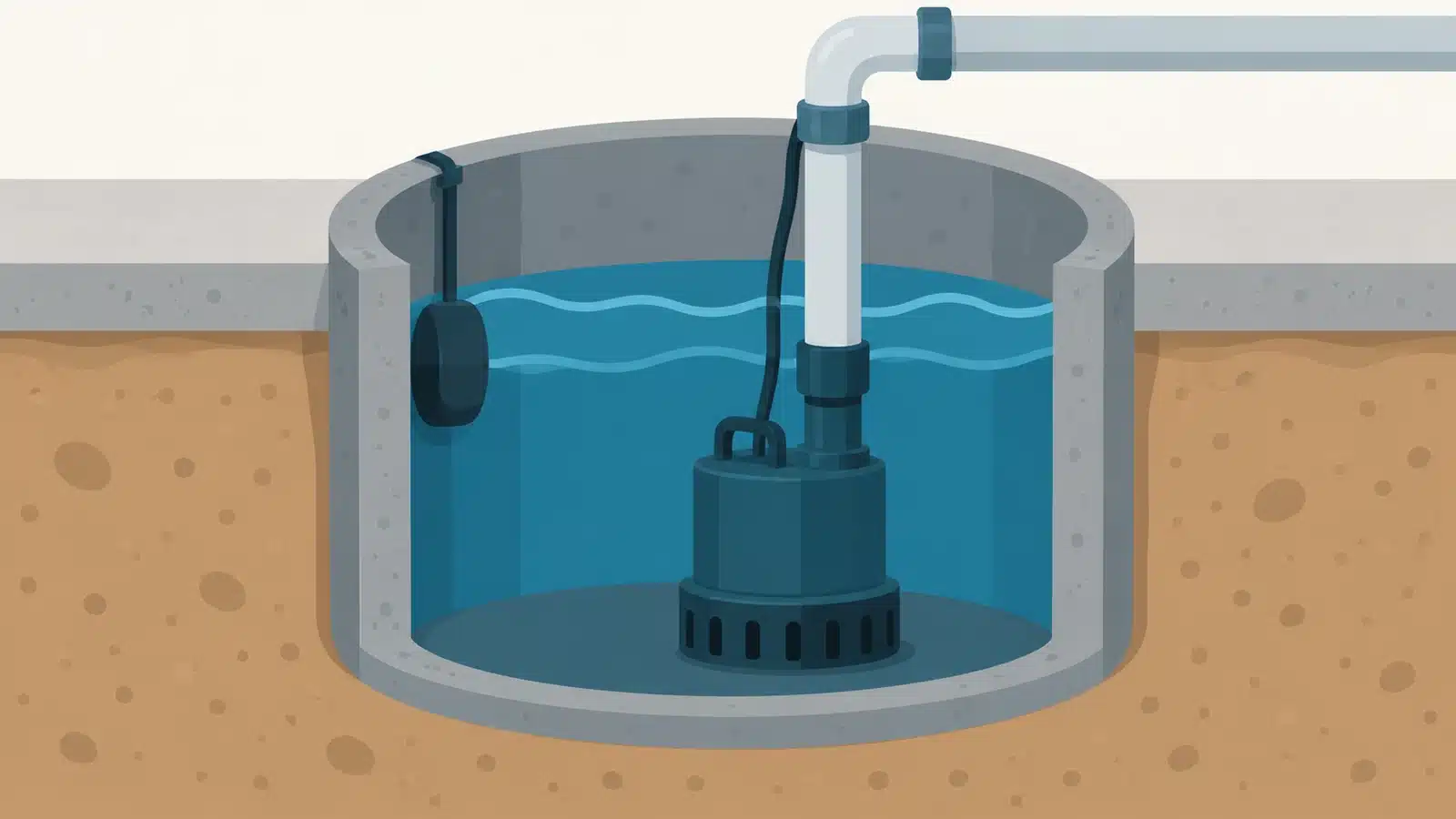
Quick answer: With a sump pump not working, the cause is usually one of five things: no power (a tripped GFCI outlet or breaker, or an outlet on a wall switch), a stuck or failed float switch, a motor that has overheated and shut itself off, a pump that runs but cannot move water (clogged inlet, air lock or a backward check valve), or a worn-out pump. Check the power first, then lift the float with a broom handle to see if the pump starts. Most sump pumps have no reset button: the motor’s thermal protector resets itself once it cools.
Is an alarm sounding as well? See sump pump alarm going off to tell a high-water alarm from a battery alarm.
Safety first: water and electricity are a dangerous mix. Do not stand in water to reach the pump or outlet; if the basement is flooding around electrical outlets or equipment, stay out and have the power shut off at the main panel. Unplug the pump before reaching into the pit, and never touch the float with your hand while the pump is plugged in. Pentair says to use “a broom handle or similar non-conducting item.”
In this guide
Sump pump not working? Match what you see
| What you see | Most likely cause | Go to |
|---|---|---|
| Completely silent, water rising, outlet dead | Tripped GFCI or breaker, or a wall switch turned off | No power |
| GFCI trips every time the pump starts | Water in the cord or switch, or a motor fault | GFCI keeps tripping |
| Silent, power is fine, starts when the float is lifted | Float stuck against the wall or debris | Float switch |
| Silent, power is fine, does not start when the float is lifted | Failed float switch or motor | Float switch / test |
| Ran hard, then stopped; starts again later on its own | Thermal overload from overheating | Overheated motor |
| Runs or hums but the water level does not drop | Clogged inlet, air lock, backward check valve or a jammed impeller | Runs but won’t pump |
| Runs all the time or turns on and off every few seconds | Float, check valve or a pump too small for the inflow | Sump pump running constantly |
| Not working after heavy rain or a storm | Power outage, overwhelmed pump, frozen or blocked discharge | After a storm |
1. No power reaching the pump
- GFCI outlet tripped: press the Reset button on the outlet (or on the GFCI outlet upstream that protects it). If it will not reset, or trips again as soon as the pump starts, see the GFCI section.
- Breaker tripped: reset it once. If it trips again, leave it off and call an electrician or plumber.
- Wall switch: Zoeller says to plug the pump into a GFCI outlet “that cannot be turned off by a wall switch.” If yours can be, someone may have switched it off.
- Extension cord or loose plug: Zoeller’s manual says “Never use an extension cord.” Plug the pump straight into its outlet.
- Power outage: a standard pump will not run without power; see battery backup sump pump.
Sump pump keeps tripping the GFCI
A GFCI does not trip because a circuit is overloaded (that is the breaker’s job). It trips when it detects current leaking to ground: the U.S. Consumer Product Safety Commission says as little as 0.006 amperes. With a sump pump, that usually means:
- Water in the cord, plug or float switch connection. Pentair lists water in the cord or float switch connector as a cause, especially on GFCI circuits. Check that the plug and outlet are dry and the cord is not cut or cracked.
- A failing motor. Pentair also lists a shorted motor winding. A pump that trips a GFCI the moment it starts, on a GFCI that holds with other appliances plugged in, usually needs replacing.
- A worn GFCI outlet. They do wear out. Test it with another appliance; CPSC recommends testing GFCIs monthly.
Do not plug the pump into a non-GFCI outlet to stop the tripping. Zoeller and Wayne manuals call for a GFCI, and the 2020 National Electrical Code added sump pumps to the appliances that need GFCI protection (section 422.5(A)(6)). Local codes vary, so ask an electrician, but the tripping is a warning that something is leaking current in a wet pit.
2. Stuck or failed float switch
Pentair says “the float switch is typically the first thing to fail,” and Zoeller’s manual says “If the float is restricted, the pump will not operate.”
- Unplug the pump and look into the pit with a flashlight. Is the float caught on the pit wall, the discharge pipe, the cord or debris? Has the pump shifted so the float rubs the side?
- Free it, plug the pump back in, and lift the float with a broom handle. If the pump starts, the switch works.
- If it does not start, try the test in how to test a sump pump to tell whether the switch or the motor has failed.
A hollow float that has filled with water, or a vertical float with a sticky rod, can also stop working. For more, see sump pump float stuck.
3. Motor overheated (thermal overload)
Most submersible pumps have a thermal protector that shuts the motor off when it gets too hot. Wayne’s manual calls it an “automatic reset thermal protector,” and ECO-FLO’s says “the motor restarts automatically after it has cooled down.” So if your pump ran hard during a storm and then stopped, unplug it and give it time to cool before testing it again. Repeated overheating points to a pump that is running too long: a clogged inlet screen, a pump too small for the inflow, a check valve leaking water back, or a pump near the end of its life.
4. Runs or hums but won’t pump water
Zoeller’s troubleshooting table lists three causes for a pump that “runs but does not deliver water”:
- Clogged inlet or impeller: unplug the pump, lift it out and clear debris, gravel or silt from the screen. Setting the pump on a solid surface rather than loose gravel helps.
- Air lock: air trapped in the pump stops it moving water. Zoeller’s fix is to clean the small vent hole in the discharge pipe (between the pump and the check valve) or drill one if there is none; see check valve weep hole.
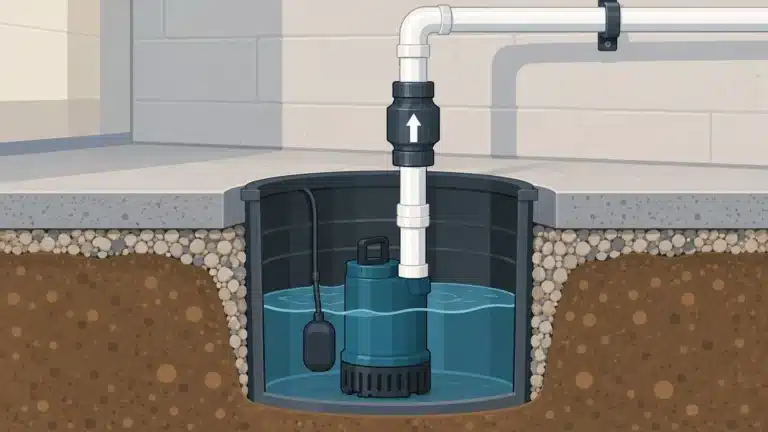
- Check valve installed backward: the arrow on the valve should point away from the pump; see sump pump check valve.
A frozen or crushed discharge line outside can also stop water leaving. If the pump hums but the impeller does not turn at all, it may be jammed or the motor may be failing; see sump pump humming but not pumping.
Sump pump not working after heavy rain
- A power cut during the storm, or a GFCI that tripped in the wet, is the most common reason. Check power first.
- The pump may have overheated after running for hours and shut off on its thermal protector.
- Water may be coming in faster than the pump can remove it, or the discharge line may be blocked or frozen.
- If water is entering where the pump cannot reach it, see water in basement after rain.
How to test a sump pump
- Make sure the pump is plugged into a working GFCI outlet.
- Slowly pour a bucket of water (about 5 gallons) into the pit. The float should rise and start the pump, which should empty the pit and shut off.
- If it does not start, lift the float with a broom handle. If it starts now, the float was the problem.
- On pumps with a “piggyback” plug, where the pump plugs into the back of the float switch plug, unplug both and plug the pump directly into the outlet. Pentair says not to leave it plugged in this way for more than a few minutes. If the pump runs, the float switch has failed; if not, the motor has.
Testing a few times a year, and before the wet season, catches most failures before a storm does.
Use your pump’s manual, a plumber for pump replacement, and a licensed electrician for any outlet or wiring work. Suggest a guide or report a correction.
What a sump pump repair usually costs
HomeAdvisor’s sump pump repair guide (updated June 17, 2026):
| Repair | Typical cost |
|---|---|
| Average repair | $531 (typical range $309 to $755) |
| Float switch replacement | $100 to $150 |
| Motor replacement | $250 to $500 |
| Submersible pump replacement | $800 to $2,000 |
For a full replacement breakdown, see sump pump replacement cost.
Frequently asked questions
Why is my sump pump not kicking on?
Usually no power (a tripped GFCI or breaker), a float that is stuck or has failed, or a motor that has overheated and is waiting to cool down. Check the outlet, then lift the float with a broom handle.
How do you reset a sump pump?
Most sump pumps have no reset button. Reset the GFCI outlet or breaker if it has tripped. If the motor overheated, unplug it and let it cool; its thermal protector resets itself.
How do I force my sump pump to turn on?
Lift the float with a broom handle or other non-conducting item. On a piggyback-plug pump you can also plug the pump straight into the outlet for a short test, but only for a few minutes and never leave it that way.
Should a sump pump be plugged into a GFCI outlet?
Yes. Pump manufacturers including Zoeller and Wayne call for GFCI protection, and the 2020 National Electrical Code requires it for sump pumps. Check your local code with an electrician.
Why does my sump pump keep tripping the breaker?
A breaker trips on overload or a short: a jammed impeller, a failing motor, or a circuit shared with other heavy loads. Zoeller says the circuit should be rated 15 amps or more. If it trips again after one reset, call a professional.
How long does a sump pump last?
InterNACHI’s life-expectancy chart for home components lists a sump pump at about 7 years; how long yours lasts depends on how often it runs and what it pumps. A pump that has started failing in its later years is usually worth replacing rather than repairing.
Related: Sump pump float stuck · Sump pump humming but not pumping · Sump pump running constantly
Sources: Zoeller 1073/1075 sump pump manual · Zoeller 1052/1096 sump pump manual · Pentair: sump pump troubleshooting FAQ · Wayne sump pump manual · ECO-FLO sump pump manual · CPSC: GFCI fact sheet · Leviton: 2020 NEC 422.5 GFCI for appliances · InterNACHI: life expectancy chart · HomeAdvisor: sump pump repair cost.
Updated October 22, 2026. Written and edited by Jordan Hale. General educational guidance; electrical work is for licensed professionals.

One Comment