Crawl Space Dehumidifier Cost (2026): Sizing and Setup
Quick answer: A professionally installed crawl space dehumidifier typically costs about $1,000 to $3,000. Quotes range from roughly $750 to $4,000 depending on capacity, drainage and electrical work. You generally need one only in a sealed or encapsulated crawl space. In a vented crawl space, it ends up trying to dry outdoor air. Expect it to add very roughly $120 to $500 a year to your electric bill.
Cost sources checked October 28, 2026: HomeGuide (2026), HomeGuide whole-house (2026), Angi (2025 data), Fixr (Jan 31, 2025), This Old House (Mar 13, 2026). U.S. dollars. Local prices vary.
In this guide
Do you need a crawl space dehumidifier?
It depends on how your crawl space is built.
| Crawl space type | Dehumidifier? |
|---|---|
| Vented (open foundation vents) | Generally no. Fix water, grading and the ground cover instead. |
| Sealed or encapsulated (unvented) | Yes, or one of the code-approved alternatives below |
| Conditioned with HVAC supply air | Sometimes, as a backup in mild, humid weather |
| Standing water or active leaks | Not yet. Stop the water first. |
Vented crawl spaces: Building scientist Allison Bailes puts it plainly: “you can’t dehumidify the whole outdoors.” Open vents keep replacing the air you just dried with humid outdoor air. In humid climates, the Department of Energy notes that outside air is often wetter than crawl space air, which can cause structural, mold and pest problems.
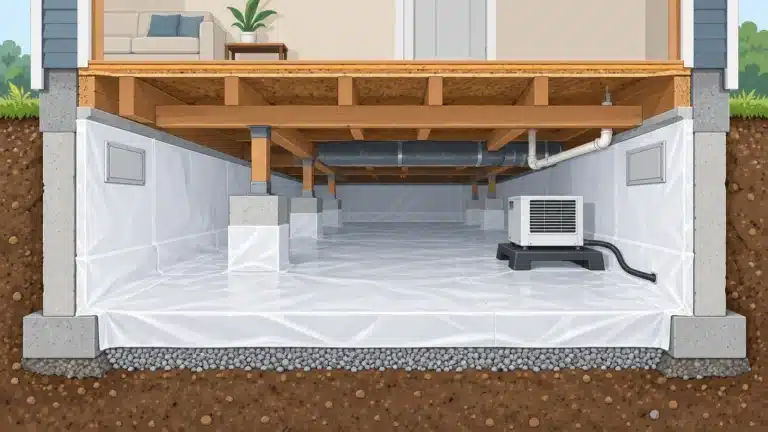
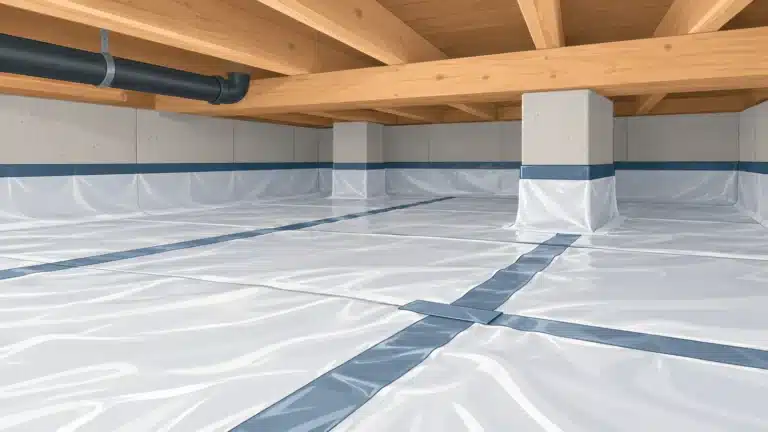
Sealed crawl spaces: Once the crawl space is closed off and connected to the house, Building Science Corporation says “there has to be a means of removing moisture.” The International Residential Code (section R408.3) requires unvented crawl spaces to have a sealed Class I vapor retarder, such as 6-mil plastic. They also need one of these: continuous exhaust, conditioned supply air, or “dehumidification sized in accordance with manufacturer’s specifications” (Larimer County, Colo., code handout, updated Apr 28, 2026). Not sealed yet? Start with how to encapsulate a crawl space.
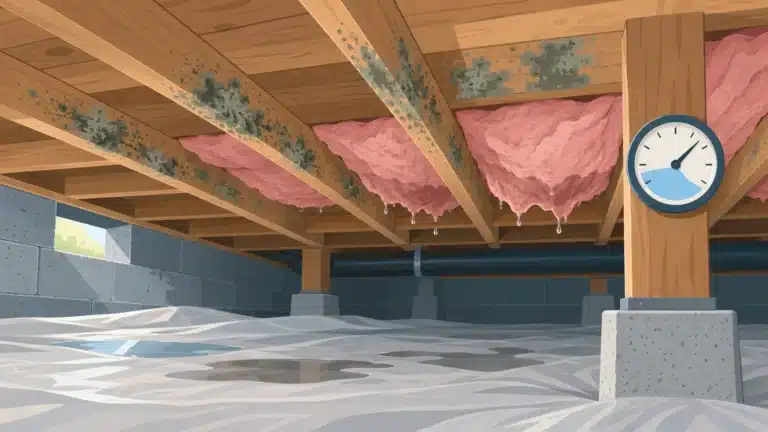
If there’s liquid water, read water in crawl space first. A dehumidifier controls humid air. It can’t keep up with a leak or seepage.
What size dehumidifier does a crawl space need?
Capacity is rated in pints of water removed per day. Angi’s sizing ranges by crawl space area:
| Crawl space area | Typical capacity | Price range (Angi) |
|---|---|---|
| Up to 1,500 sq ft | 30–50 pints/day | $150–$600 |
| 1,500–2,500 sq ft | 50–70 pints/day | $450–$1,400 |
| 2,500–3,500 sq ft | 70–120 pints/day | $1,400–$2,500 |
| 3,500+ sq ft | 120+ pints/day | $2,500–$4,000 |
Source: Angi (2025 data). Angi suggests going one size category above your calculated need. It also says household units of 25–30 pints are too small for a crawl space.
- Wetter spaces need more capacity. ENERGY STAR says capacity depends on both area and how damp the space is, and that “it’s better to oversize than undersize.”
- Compare ratings carefully. In 2019 the federal test procedure changed. Portable units are now tested at 65°F instead of 80°F, which produces lower ratings. ENERGY STAR estimates an old 70-pint portable rating is now about 40–45 pints, and an old 80-pint whole-home rating is about 70.
- Manufacturer coverage claims vary. As one example, a manufacturer spec sheet lists a 70-pint/day crawl space unit (rated at 80°F and 60% RH) as “sized for 1800 sq. ft. – typical.” The code defers to the manufacturer’s sizing, so ask the installer which spec they used.
How much does a crawl space dehumidifier cost?
| Source (date shown) | Unit only | Installed |
|---|---|---|
| HomeGuide (2026) | $300–$2,000 | $1,000–$3,000 |
| HomeGuide whole-house guide (2026) | $800–$1,600 | $1,500–$2,500 |
| Fixr (Jan 31, 2025) | Not listed | $750–$1,700 |
| This Old House (Mar 13, 2026) | Not listed | $800–$2,000, including wiring |
| Angi crawl space guide (2026 data) | Not listed | $1,000–$4,000 |
Most installed quotes land between $1,000 and $3,000. Angi puts a typical refrigerant unit at about $1,500 for an average crawl space and a desiccant unit at about $2,000. It estimates around $3,000 to buy and install a unit in an already-encapsulated crawl space. By capacity, HomeGuide lists installed prices of $1,000–$2,500 for 50 pints, $1,200–$2,700 for 60 pints, and $1,500–$3,000 for 70 pints.
Other costs
| Item | Typical cost | Source |
|---|---|---|
| Add-on condensate pump | $50–$300 | HomeGuide |
| Replacement filter | $10–$30 | HomeGuide |
| Repairs | $70–$400 | HomeGuide |
| Removing an old unit | $40–$200 | HomeGuide |
| Labor | $50–$120 per hour | Angi |
| Encapsulation including a dehumidifier | $3,000–$8,000 | HomeGuide |
For the full sealing job, see crawl space encapsulation cost.
Operating cost
HomeGuide estimates $10–$30 a month, or about $120–$360 a year. Angi estimates $300–$500 a year in added electricity. Its figure is lower with good encapsulation and higher in wet climates. For scale, the spec sheet above lists 580 watts for a 70-pint unit at its rated test conditions (80°F, 60% RH). ENERGY STAR certified dehumidifiers use about 20% less energy than comparable conventional models.
Drainage: gravity drain or condensate pump?
A crawl space unit runs for long stretches, so it needs a continuous drain, not a bucket you empty.
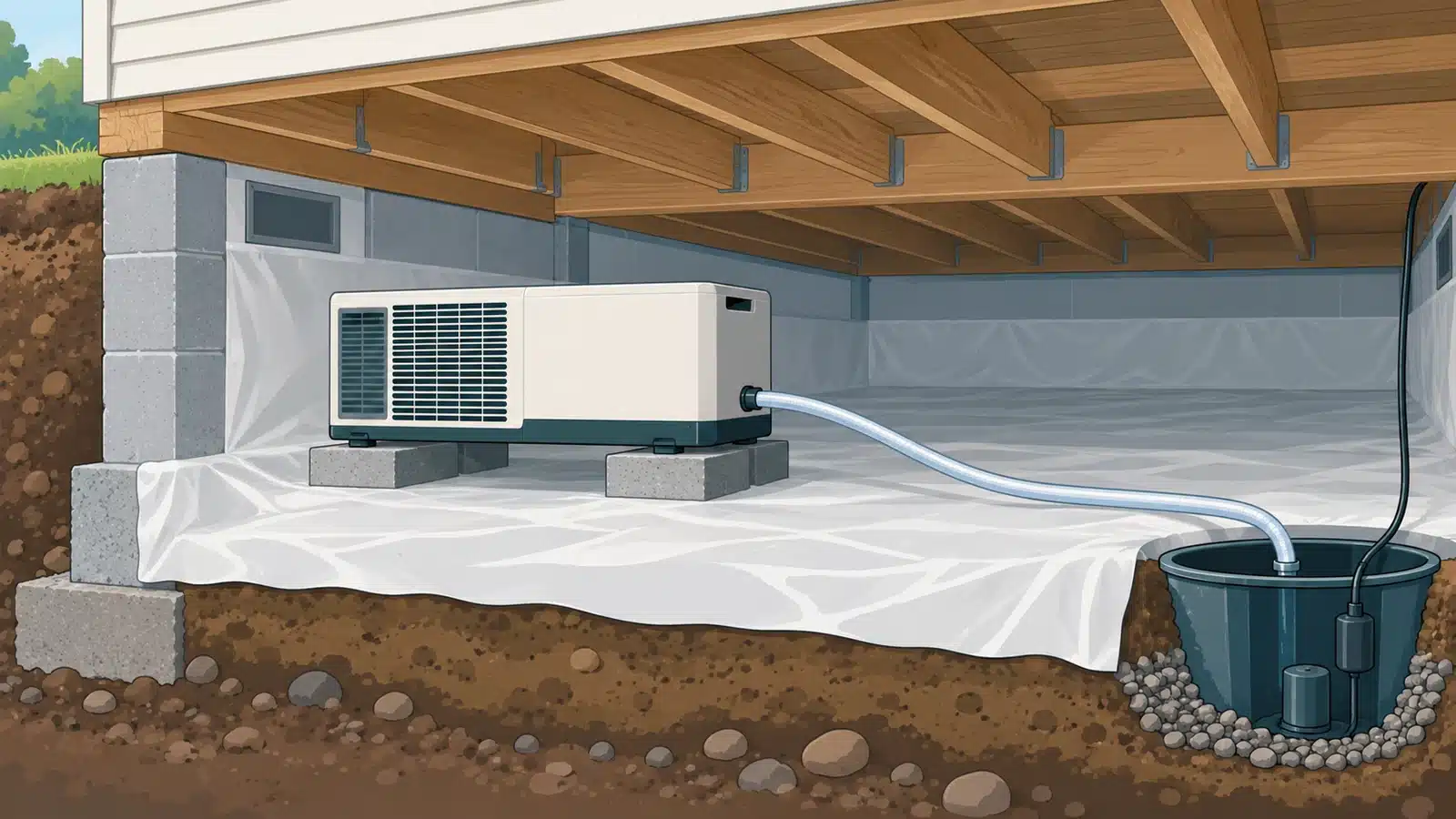
- Gravity drain: A hose runs downhill to a sump pit, floor drain or an outlet lower than the unit. It’s simple, with nothing to fail except a clog. ENERGY STAR recommends draining to a floor drain or sump and keeping drain hoses away from electrical cords.
- Condensate pump: You need one when there’s no lower outlet, which is common when water has to go up and out through the rim joist. Some units have one built in. An add-on pump runs about $50–$300.
- Don’t dump water at the foundation. Discharge outside should run away from the house. Otherwise the water can soak back into the crawl space.
Bailes lists water damage if the drain fails as a drawback of crawl space dehumidifiers. Check the line and pump regularly.
Safety first: Have an electrician confirm the circuit and outlet. Crawl space outlets have code requirements, including GFCI protection where required. Don’t run a crawl space unit on an extension cord lying on damp ground.
What humidity setting, and how much upkeep?
Set the unit at or below 60%. The EPA recommends keeping indoor humidity below 60%, ideally 30–50%. The CDC says no higher than 50%. For comparison, Bailes notes mold growth can take off around 70% RH. Use a separate hygrometer to confirm the unit’s reading.
| Task | How often | Source |
|---|---|---|
| Clean or replace the filter | Every 3–6 months (Angi). At least once a year (HomeGuide). | Angi; HomeGuide |
| Professional inspection | Every 12–18 months | Angi |
| Check drain line, pump and discharge | Regularly, and after any alarm | General practice |
| Expected lifespan | 5–10 years for whole-house units; 3–5 years for portables | HomeGuide |
Keep dust away from the coils. ENERGY STAR notes that dust and dirt can clog coils and grills. Also mind operating temperature: the example unit above runs from 49°F to 95°F. ENERGY STAR warns that coils can frost when air drops below about 65°F, which matters for basic portable units.
Alternatives to a dehumidifier
| Option | How it works | Trade-offs |
|---|---|---|
| Conditioned supply air | A small HVAC supply duct delivers 1 cfm per 50 sq ft of crawl space, with a return air path to the house (IRC, per Larimer County) | The most common method in encapsulated crawl spaces. It may not work well in mild seasons or with an oversized AC (Bailes). |
| Continuous exhaust fan | Pulls crawl space air out at 1 cfm per 50 sq ft while house air flows in. For a 2,000 sq ft crawl space, that’s 40 cfm. | Less predictable, because the makeup air path is uncertain (Bailes) |
| Dehumidifier | Responds to conditions in the crawl space itself | Higher cost, filter and drain upkeep, and leak risk if the drain fails |
Sealing a crawl space can trap soil gases such as radon. Building Science Corporation recommends a sub-membrane vent for radon and soil gases. Bailes notes that sealing may need to wait if atmospheric combustion appliances are in the space. If you already have mold, deal with it first; see crawl space mold.
Can I use a regular dehumidifier in my crawl space?
It’s usually a poor fit. Angi says typical 25–30 pint household units are too small for a crawl space. They also need a hose drain. HomeGuide puts portable lifespans at 3–5 years versus 5–10 for whole-house units. ENERGY STAR notes coils can frost below about 65°F.
Should I run a dehumidifier in a vented crawl space?
Generally no. With the vents open, the unit keeps drying fresh outdoor air and runs constantly. Fix water problems first, then decide whether to seal and encapsulate the space.
How much does it cost to run a crawl space dehumidifier?
HomeGuide estimates $10–$30 a month. Angi estimates $300–$500 a year in added electricity. Your cost depends on your electric rate, climate, how well the space is sealed, and the unit’s efficiency.
Do I need a dehumidifier if I have a vapor barrier?
A ground vapor barrier in a vented crawl space doesn’t require one. If the crawl space is fully sealed, the code requires some way of removing moisture: a dehumidifier, conditioned supply air or a continuous exhaust fan.
What humidity should a crawl space dehumidifier be set to?
At or below 60%. That keeps the space under the EPA’s ceiling for indoor humidity. The EPA’s ideal range is 30–50%, and the CDC says no higher than 50%.
Updated October 28, 2026. Written and edited by Jordan Hale. General educational guidance; use a qualified professional for structural, electrical or mold work.