Mold in Crawl Space: Signs, Safe Removal and Costs
Quick answer: Mold in crawl space wood, insulation or soil comes from moisture. Removal only lasts if you also fix the water or humidity that feeds it. The EPA says a homeowner can usually clean a patch smaller than about 10 square feet. Bigger areas, mold after sewage or flooding, or a household member with asthma or a weakened immune system call for a professional. That usually costs about $500 to $4,000 for a crawl space.
In this guide
Signs of mold in a crawl space
- A musty smell in the crawl space, sometimes noticeable in the rooms above
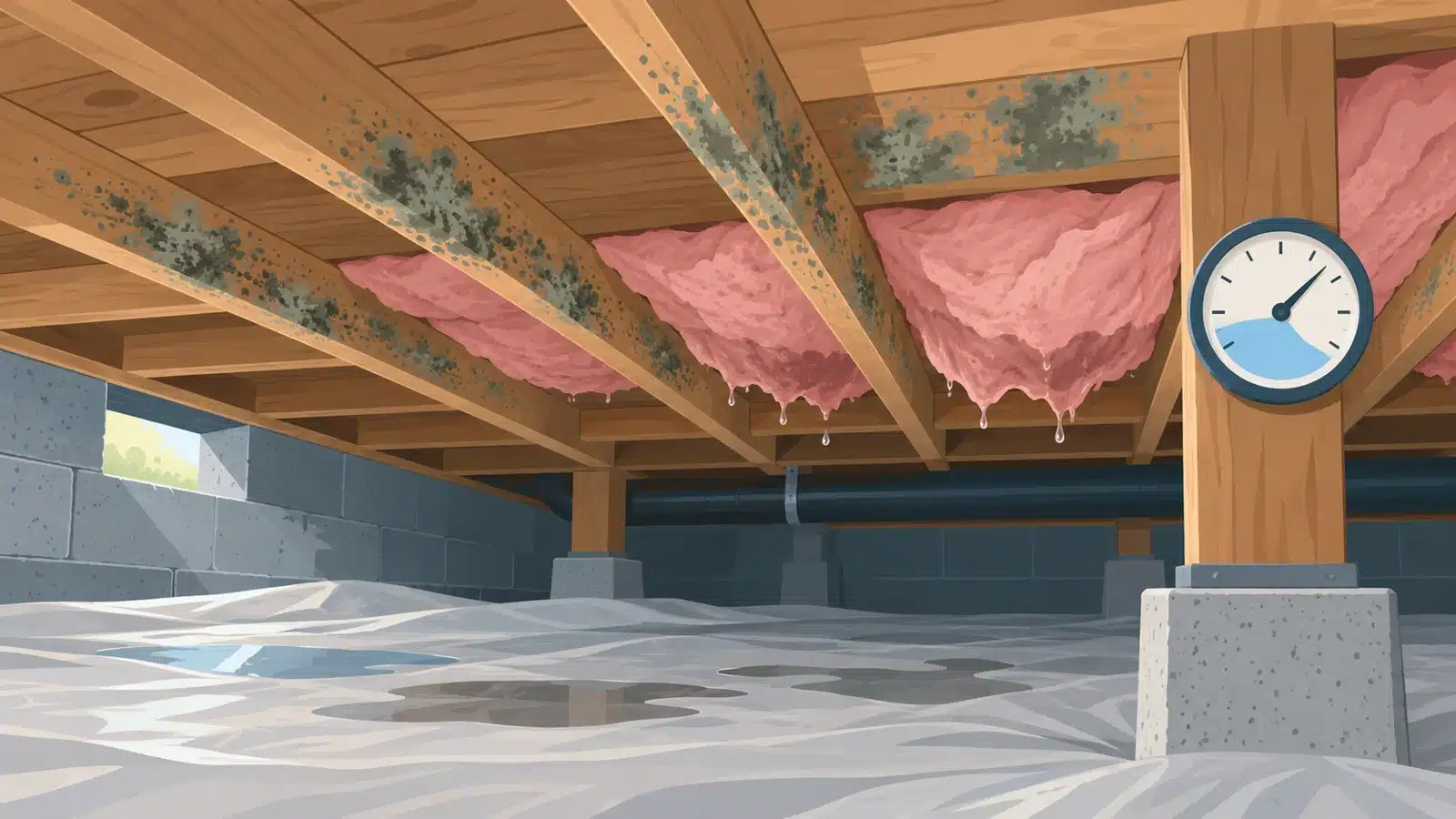
- Fuzzy, spotty or blotchy growth on joists, the subfloor or the sill plate. It can be white, gray, green or black.
- Insulation that is damp, stained or sagging between the joists
- Water droplets on ducts, pipes or the vapor barrier in summer
- Standing water, wet soil or a torn or missing ground cover
Not every white deposit is mold. Crusty white crystals on concrete block or masonry are often mineral salts left behind as water moves through the wall. They still tell you water is getting in.
What causes it
| Cause | What to look for |
|---|---|
| Humid outdoor air in a vented crawl space | Growth and condensation peak in summer. Allison Bailes reports that mold growth can take off around 70% RH, and that vented crawl spaces in humid climates often run higher. |
| Rain runoff and poor grading | Wet soil or puddles after storms, especially under downspouts |
| Plumbing leaks | A wet area under a pipe or drain, even in dry weather |
| Bare soil, no vapor barrier | Exposed dirt floor, or a barrier with gaps and torn seams |
| Leaky ductwork | Ducts in the crawl space. Bailes notes that leaky ducts add to crawl space moisture problems. |
If you find standing water, start with our guide to water in a crawl space. Cleaning mold before the water is fixed doesn’t last.
Is mold in a crawl space dangerous?
Federal health agencies describe the risks carefully:
- The EPA says inhaling or touching mold or spores may cause allergic reactions in sensitive individuals. It can also cause asthma attacks in people with asthma who are allergic to mold.
- The CDC says people with asthma or mold allergies may have severe reactions. Immune-compromised people and people with chronic lung disease may get lung infections from mold. Exposure “may cause a variety of health effects, or none at all.”
- The CDC advises that people with allergies, immune suppression, lung disease, asthma or COPD avoid doing mold cleanup themselves.
The EPA’s advice is simple: if you have health concerns, consult a health professional before starting cleanup.
Safety first: A crawl space is a tight, dark space and may have exposed wiring, pests or sharp debris. Don’t go in if there’s standing water near electrical equipment. Tell someone you’re going in, and never mix bleach with ammonia or other cleaners. The CDC and EPA both warn about this.
Can you remove crawl space mold yourself?
The EPA says that if the moldy area is less than about 10 square feet (roughly a 3 ft by 3 ft patch), you can usually handle it yourself. Bigger jobs, or significant water damage, call for EPA’s professional remediation guidance.
| Situation | DIY or pro? |
|---|---|
| Small patch (under about 10 sq ft) on wood or other hard surfaces, moisture source fixed, no one with health concerns doing the work | DIY is reasonable |
| Mold covering more than about 10 sq ft | Hire a pro (EPA) |
| Mold after sewage or other contaminated water | Hire a pro with relevant experience (EPA) |
| Mold on or in HVAC equipment or ducts in the crawl space | Hire a pro. Consult them before running the system (This Old House). |
| The person cleaning has asthma, allergies, lung disease or a weakened immune system | Someone else should do it (CDC) |
Protective gear
- A respirator: at least a NIOSH-approved N95, per the CDC
- Long gloves that reach the middle of the forearm, per the EPA
- Goggles without ventilation holes, per the EPA
- Old clothes or disposable coveralls you can bag up afterward
Small-area cleanup steps
- Fix the moisture first. In the EPA’s words, “the key to mold control is moisture control.”
- Bag and remove moldy insulation. The EPA says absorbent or porous materials may have to be thrown away if they become moldy.
- Scrub hard surfaces with detergent and water, then dry them completely (EPA).
- Go easy on bleach. The EPA says a biocide such as chlorine bleach is not recommended as a routine part of mold cleanup. If you do use bleach, the CDC says to use no more than 1 cup per gallon of water and to ventilate the area.
- Don’t paint over it. The EPA says not to paint or caulk moldy surfaces. Clean first.
- Dry and monitor. Run a dehumidifier or fans and check with a hygrometer for a few weeks.
How much does crawl space mold removal cost?
| Source (date shown) | Crawl space mold removal | Per sq ft |
|---|---|---|
| This Old House (Mar 11, 2026) | $500–$2,000, higher for limited-access crawl spaces | $10–$25 |
| HomeGuide (Feb 5, 2026) | $1,500–$4,000 | $15–$30 (all mold removal) |
| Fixr (Aug 29, 2025) | $500–$2,000 | $10–$30 |
| Angi (2026 data) | $1,000–$3,500 | Not listed |
| HomeAdvisor (2025) | $1,000–$6,000 | Not listed |
Most estimates fall between $500 and $4,000. The spread comes down to how much is affected, how hard the space is to work in, and whether insulation has to come out. Other costs to plan for:
- Mold testing: $300–$650 for an average home (HomeGuide). A separate inspection runs $450–$800, though some companies waive it (Fixr).
- Insulation removal and replacement: $1–$4.50 per sq ft (HomeGuide).
- Air ducts, walls and insulation included: $2,000–$6,000. Widespread structural damage runs $10,000–$30,000 (HomeGuide).
Do you need a mold test?
Usually not. The EPA says that in most cases, if visible mold growth is present, sampling is unnecessary. It also notes that no EPA or other federal limits have been set for mold or mold spores. The CDC is more direct: it does not recommend mold testing, and says the best step is to remove the mold safely and prevent regrowth.
Testing can still help in two cases. One is when you smell mold but can’t find it. The other is after remediation, to confirm cleanup. The EPA says surface sampling may help confirm an area was adequately cleaned, and that professionals should do it. If you pay for testing, ask whether the tester is independent of the company doing the removal.
What a remediation quote should include
- The affected area in square feet and what will be removed versus cleaned
- Containment, cleaning methods and equipment such as HEPA vacuums and air scrubbers
- Whether testing before and after is included, and disposal fees for contaminated material. HomeGuide notes some companies add hazardous waste disposal fees.
- Repairs listed separately, such as insulation, subfloor or joists
- Whether the moisture source is addressed, or only the mold
- That they follow EPA guidance and industry standards such as IICRC’s. The EPA suggests asking contractors about both and checking references.
- Warranty terms and what voids them
Compare bids on the same scope. HomeGuide advises confirming that each bid includes the same testing, cleanup and containment.
How to keep mold from coming back
- Stop liquid water. Fix gutters, downspouts, grading and leaks. See water in crawl space.
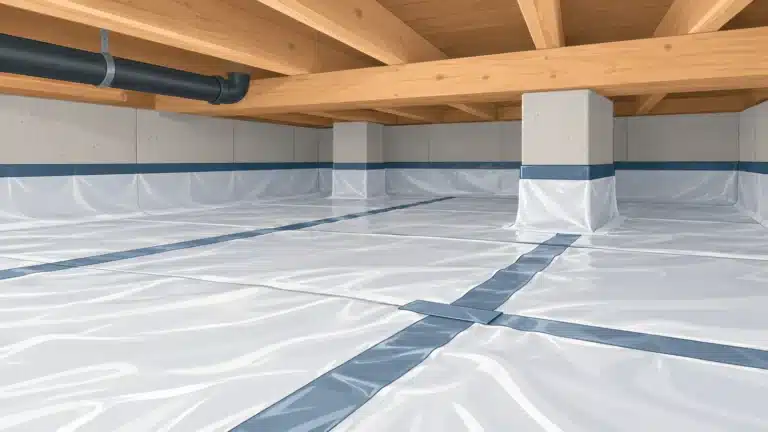
- Cover the ground. The Building America Solution Center recommends 6-mil or thicker polyethylene over the whole floor, with seams overlapped 6–12 inches and taped. Details in our vapor barrier guide.
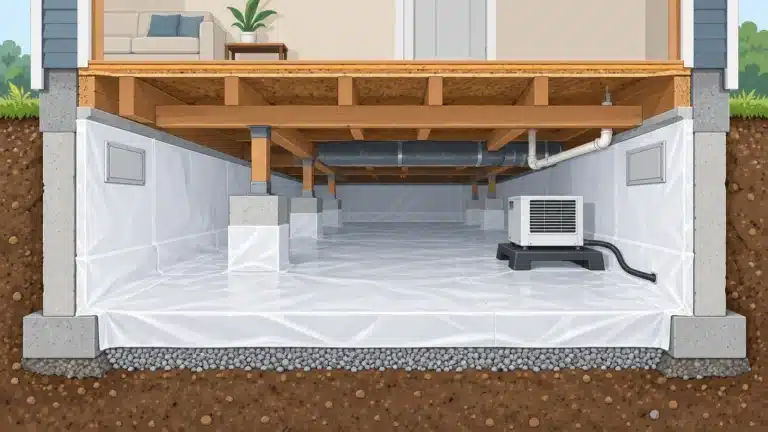
- Consider encapsulation in humid climates. This Old House puts it at $1,500–$15,000, averaging about $5,500. See encapsulation cost and how to encapsulate a crawl space.
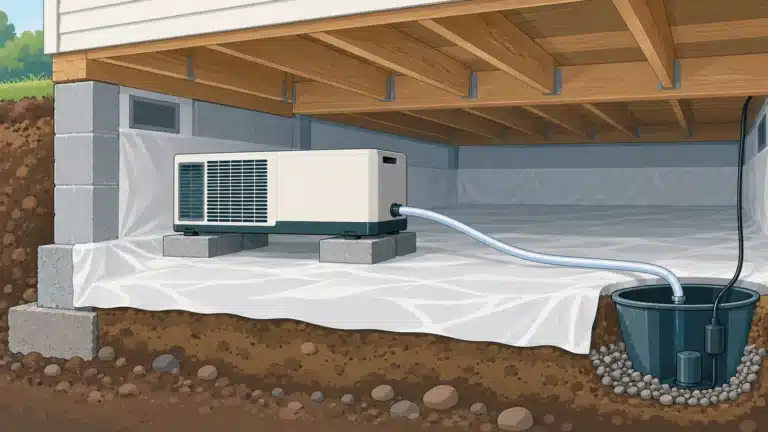
- Control humidity. In a sealed crawl space, that means a crawl space dehumidifier or conditioned supply air. The EPA recommends keeping indoor humidity below 60%, ideally 30–50%.
- Monitor. A hygrometer and a check after heavy rain catch problems early.
Is it normal to have mold in a crawl space?
It’s common, especially in vented crawl spaces in humid climates, but it isn’t harmless or something to ignore. It means the space is too wet, and the moisture behind it can also damage wood framing.
Can mold in a crawl space make you sick?
According to the EPA and CDC, mold can trigger allergic reactions and asthma attacks in sensitive people. People with weakened immune systems or chronic lung disease may develop lung infections. Many people have no effects. If you have symptoms, talk to a doctor.
Does bleach kill mold in a crawl space?
The EPA doesn’t recommend bleach as a routine part of mold cleanup. Scrubbing with detergent and water, drying completely and fixing the moisture matter more. If you use bleach, the CDC says to use no more than 1 cup per gallon, ventilate, and never mix it with ammonia.
Will encapsulation get rid of existing mold?
No. Encapsulation helps prevent new growth by controlling moisture, but existing mold should be cleaned or removed first. The EPA advises against covering moldy surfaces with paint or caulk.
Updated October 28, 2026. Written and edited by Jordan Hale. General educational guidance; use a qualified professional for structural, electrical or mold work.