Tankless Water Heater Not Heating? Causes and Fixes
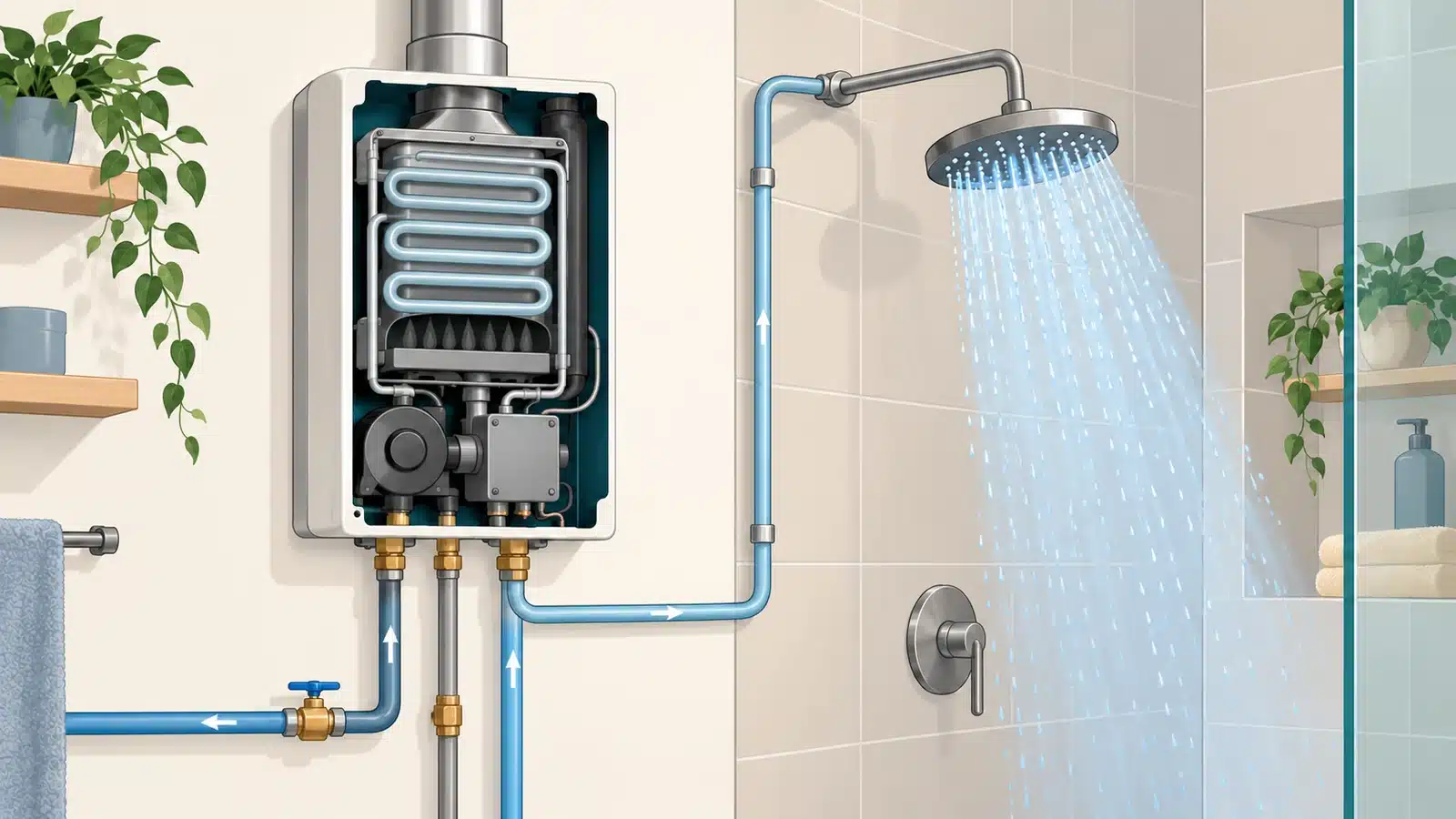
Quick answer: A tankless water heater not heating is usually getting too little flow to fire, being asked for more hot water than it can heat, short of gas, scaled up, or shut down by a fault code. Start with the easy checks: power and the gas valve, the error code, a wide-open hot tap, and how many fixtures are running. Lukewarm water that gets worse every winter is often a sizing limit, not a fault. Leave gas pressure, venting and internal repairs to a licensed technician.
Safety first: if you smell gas, leave and call your gas utility or 911 from outside; see water heater gas leak. On an electric tankless unit, if a breaker trips twice, leave it off and call an electrician. Do not open the unit’s cover; parts inside are live and hot.
In this guide
Match your symptom
| What you notice | Most likely cause | Go to |
|---|---|---|
| No hot water anywhere, display blank | No power: breaker, plug or outage | Check power first |
| No hot water, code on the display | Ignition, flame, gas or venting fault | Error codes |
| Cold at a trickle, hot with the tap wide open | Flow below the activation rate | Cause 1 |
| Fine at one tap, lukewarm when two or more run | Demand above capacity, or gas supply | Cause 2 and cause 3 |
| Lukewarm mainly in winter | Colder incoming water: a sizing limit | Cause 2 |
| Heat getting weaker over months | Scale or a clogged inlet filter | Cause 4 |
| Only one fixture is lukewarm | That fixture’s mixing valve or limit stop, or crossover | Cause 5 |
| Brief cold burst between two hot uses | Normal “cold water sandwich” | Cause 6 |
First checks anyone can do
- Power: gas tankless units need electricity too. Rinnai notes its heaters “will not operate” during a power outage. Check the breaker or plug and the controller display.
- Gas: make sure the gas valve to the unit is fully open and, on propane, that the tank has fuel. If other gas appliances work and this one does not, note any code.
- Water valves: both isolation valves under the unit must be fully open. A part-closed valve after a flush is a common cause of weak flow.
- Temperature setting: check the set temperature on the controller, and that nobody has lowered it.
- Error code: write down any code before resetting, then follow the manual.
Tankless water heater not heating: the usual causes
1. Flow is too low to fire the burner
A tankless heater only lights when enough water flows through it. Below that, the water passes through cold.
| Model (example) | Flow needed to start heating |
|---|---|
| Rinnai (general) | 0.4 to 0.6 gallons per minute; 0.26 to keep running |
| Rinnai RUR98 condensing | 0.4 gallons per minute |
| Navien NPE-2 series | 0.5 gallons per minute |
| EcoSmart ECO 27 (electric) | 0.3 gallons per minute |
Clogged faucet aerators and shower heads, low-flow fixtures and a single-handle faucet set mostly to cold can all drop the hot-side flow below this. Open the hot tap fully to test, then clean aerators and shower heads. Your model’s spec sheet gives its exact figure.
2. More hot water than the unit can heat, especially in winter
A tankless heater can raise a certain flow by a certain number of degrees. The colder the incoming water, the bigger the rise it has to make and the less hot water it can deliver. Navien’s specification sheet shows the effect for its NPE-240A2:
| Temperature rise needed | Hot water flow (NPE-240A2) |
|---|---|
| 35°F (for example 85°F water in, 120°F out) | 11.2 gallons per minute |
| 45°F (75°F in) | 8.7 gallons per minute |
| 67°F (53°F in) | 5.6 gallons per minute |
So the same heater that runs two showers and a dishwasher in summer may only manage one shower in a cold-water winter. If water is hot at one tap but lukewarm when several run, try running fewer fixtures at once. Noritz names this as a common cause. If it happens every day, the unit may be undersized for the house, which a plumber can check.
3. Not enough gas
A gas tankless heater burns far more gas at full fire than a tank heater. If the gas pipe is too small or too long, or the supply pressure is low, the unit cannot reach full output, so water goes lukewarm when demand is high or other gas appliances run. Rinnai’s diagnostic guide links flame failure and ignition codes to low gas pressure and says the gas system “may be undersized.” Navien lists natural gas supply pressure of 3.5 to 10.5 inches of water column for the NPE-2. Measuring gas pressure and resizing gas pipe are jobs for a licensed gas fitter. See Rinnai code 12.
4. Scale or a clogged inlet filter
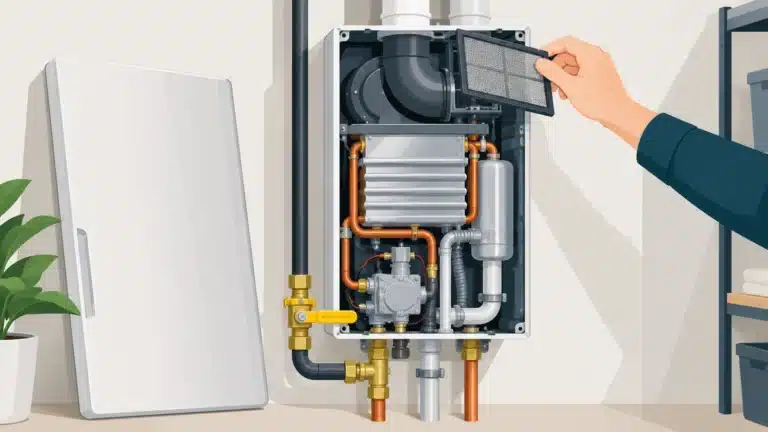
Minerals in the water build up inside the heat exchanger and restrict flow and heat transfer, so performance fades over months. Rinnai says to flush mineral deposits “at least once a year,” and more often with hard water. Some Rinnai models show an “LC” code when scale is building up. Many units also have a small screen filter at the cold water inlet. Rinnai says it “should be checked periodically for debris and cleaned,” and Navien’s maintenance tips describe rinsing and brushing it clean. Follow your manual, with the unit off and the water valves closed.
5. Cold water crossing into the hot line
If only one fixture is lukewarm, its mixing cartridge may be worn or its limit stop set too low. Rinnai notes that “many single-handle faucets have limit stops that affect the hot/cold mix and may need to be adjusted.” If several fixtures are lukewarm, cold water may be crossing into the hot line through a faulty mixing valve somewhere in the house; Rinnai’s manual calls this “bleed over.” A plumber can find it. A common check is to close the cold water valve to the heater, then open a hot tap: if water keeps flowing, cold is getting into the hot lines somewhere.
6. A brief cold burst between uses (normal)
Turn the hot water off and back on quickly, and you may get a few seconds of cooler water as the burner relights and the line clears. Rinnai says it is “normal to have a slight 1 – 2 second temperature drop.” A recirculation system or a small buffer tank can reduce it. It is not a fault.
7. A blocked vent or air intake
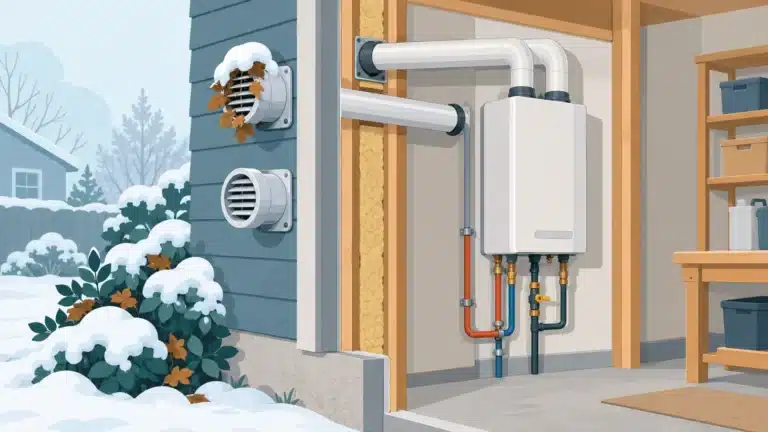
Snow, leaves, nests or debris at the outside vent terminal can shut the burner down, usually with a code. Check from outside that the terminal is clear, without taking anything apart. Vent repairs are for a technician.
8. Frozen or damaged after a cold snap
Freeze protection needs power. Rinnai’s manual says freeze protection may not work without electricity and that warranty does not cover freeze damage. If the unit froze, follow the manual’s thawing steps and have it checked for leaks before using it. See tankless water heater leaking.
Electric tankless units: power is the usual limit
Electric tankless heaters draw very large currents and often run on several breakers. If one breaker trips, the unit may still run but only heat partly. EcoSmart, for example, lists these requirements:
| Model | Breakers | Wire | Household service |
|---|---|---|---|
| ECO 27 | Three 40-amp double-pole | Three No. 8 AWG | 200 amps |
| ECO 18 | Two 40-amp double-pole | Two No. 8 AWG | 150 amps |
| ECO 11 | One 60-amp double-pole | One No. 6 AWG | 125 amps |
Check that every breaker for the unit is on. If one keeps tripping, or the house has smaller service than the unit needs, call an electrician. Stiebel Eltron’s sizing guide also advises going up one model size where the supply is 208 volts rather than 240, because the unit heats less on the lower voltage.
Error codes
Write down the code, check the manual, and reset once by the manual’s method. If the code comes back, stop resetting and call a technician. Guides to common codes: Rinnai code 12 (flame failure), Navien E012 (flame loss) and Navien E110.
Use your heater’s manual or a licensed technician for gas, venting and electrical work. Suggest a guide or report a correction.
What a repair usually costs
Angi puts professional tankless repairs at $220 to $960, with about $590 as a typical cost to fix heating problems (updated July 8, 2026). A descaling service, a cleaned filter or an opened valve costs far less; gas line upgrades, heat exchanger work and control board replacements cost more. Ask for an itemized quote, and for a recurring sizing or gas supply problem ask whether the fix is the unit or the house.
Frequently asked questions
Why is my tankless water heater running but not heating?
If the display is on but the water stays cold, the flow may be too low to fire the burner, the gas supply may be off or low, or the unit may have shut down with a code. Open the hot tap fully, check the gas valve and look for a code.
Why does my tankless water heater go hot, then cold, then hot?
A short cold burst when you turn the water back on is the normal “cold water sandwich.” If the temperature swings while water is running, the flow may be hovering near the activation rate or the gas supply may be struggling. Try opening the tap further.
Why is my tankless water heater lukewarm in winter?
The incoming water is colder, so the unit has to heat it more and can deliver less hot water at the same temperature. Run fewer fixtures at once; if it is a daily problem, the unit may be undersized for winter conditions.
How do I reset a tankless water heater?
Most units reset by turning the power off and on, or with a button on the controller; your manual gives the exact method. Reset once. If the same code returns, the cause needs a technician.
How often should I flush a tankless water heater?
Rinnai says at least once a year, and Navien recommends annual maintenance, more often with hard water. Follow your model’s manual.
Can low-flow shower heads stop a tankless heater from working?
Yes, if the hot-side flow drops below the unit’s activation rate, especially when the shower is mixed mostly with cold water. Cleaning the head or choosing one with a slightly higher flow often fixes it.
Related: Water heater not heating · Tankless water heater leaking · Navien condensate trap leaking
Sources: Rinnai: FAQ · Rinnai RUR98 specification sheet · Rinnai: diagnostic codes · Rinnai installation and operation manual · Navien NPE-2 specification sheet · Navien: maintenance tips · Noritz: troubleshooting · EcoSmart: electrical requirements · Stiebel Eltron: Tempra sizing guide · Angi: tankless repair costs. Model-specific instructions take priority.
Updated October 22, 2026. Written and edited by Jordan Hale. General educational guidance; follow your exact model instructions.