Rinnai Code 12: Flame Failure and What You Can Check
Quick answer: Rinnai code 12 is flame failure: the burner lit, then the flame went out or stopped being sensed, so the heater shut off the gas. The owner checks are limited: confirm gas is turned on at the heater and at the meter or propane tank, check that nothing is blocking the vent terminal outside, make sure the unit has power, and reset once. Rinnai’s own troubleshooting documents are written for trained professionals, and most code 12 causes, such as gas pressure, the flame rod, venting, and grounding, need a technician.
No code on the display, and the water is just lukewarm? See tankless water heater not heating.
Safety first: If you smell gas, Rinnai’s instructions are to not light any water heater, not touch any electrical switch, and call your gas supplier from a neighbor’s phone, or the fire department if you cannot reach the supplier. Do not adjust the gas valve, do not operate the heater with the front panel off, and never run it with the intake or exhaust disconnected. Hot exhaust and vent parts can cause serious burns.
In this guide
What Rinnai code 12 means
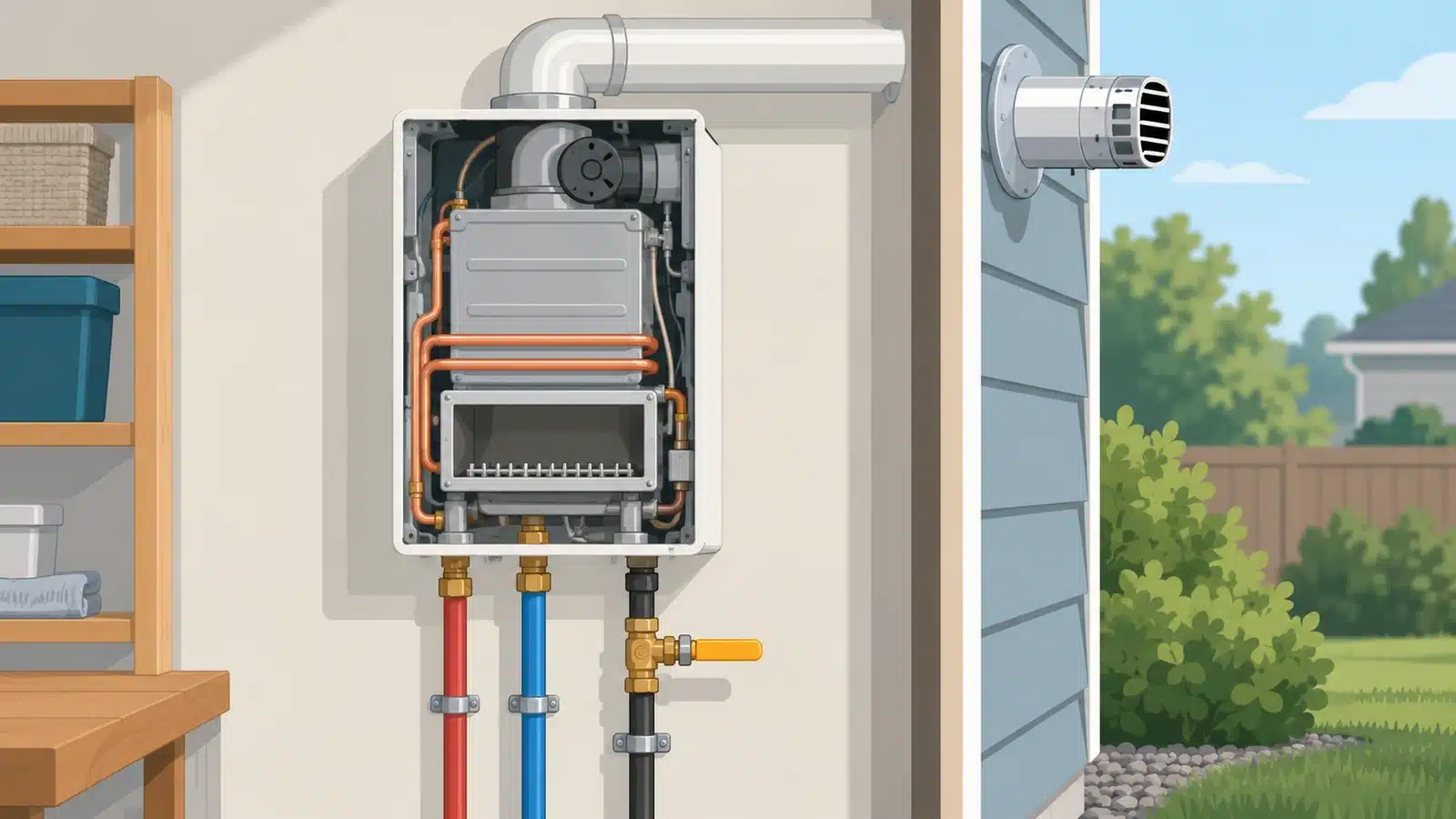
Rinnai’s condensing water heater error-code bulletin (TB-075) lists code 12 as Flame Failure. The heater ignited, and then the flame rod stopped detecting a flame during operation. The control closes the gas valve and shows the code. Rinnai’s tankless diagnostic-code troubleshooting document adds that loose flame rods or electrodes can lead to a code 11 or 12, and that a code 12 appearing immediately after water flow begins points to an electrical short in a component.
That makes code 12 different from code 11, No Ignition, where the burner never lights, and from code 10, Air Supply or Exhaust Blockage, where the airflow is the problem. All three can look the same from the shower: the water goes cold. The display tells them apart.
Owner-level checks
Rinnai states that only trained and qualified professionals are permitted to follow its diagnostic-code troubleshooting document. The checks below are the ones that do not involve opening the heater or touching gas or electrical components.
- Confirm gas is on. TB-075’s first check for code 12 is that the gas is turned on at the water heater and at the gas meter. For propane, also confirm the tank is not empty. If a range, furnace, or other gas appliance has also stopped, the supply is the problem, not the heater.
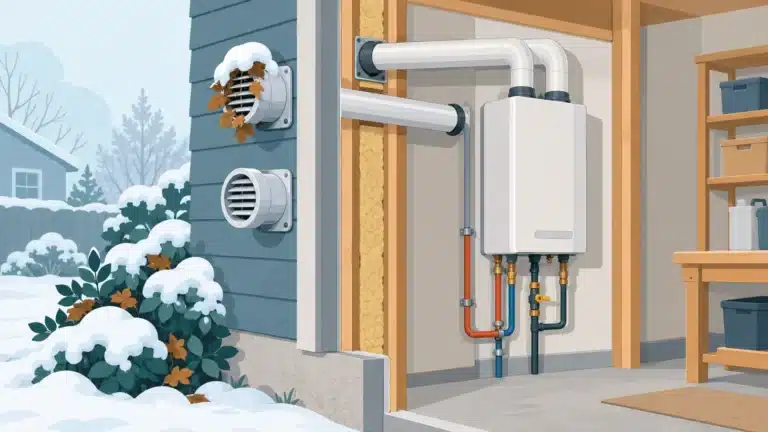
- Look at the vent terminal outside. TB-075 lists checking for obstructions in the flue outlet. Look for leaves, snow, ice, a nest, or anything placed against the terminal, and clear it from the outside only. Do not open or disconnect vent pipe.
- Check power. TB-075 lists checking the power supply for proper voltage and voltage drops. For an owner that means confirming the heater has power, is plugged directly into a grounded outlet with no extension cord, and that the circuit breaker is on. Measuring voltage is a technician’s job.
- Reset once. Turn the controller off and on, or follow the reset method in your model’s owner’s manual. If code 12 clears and stays clear, note the date and what was happening when it appeared.
- If it returns, stop. A heater that keeps losing its flame needs its gas pressure, flame rod, and venting checked. Repeated resets do not change the cause, and Rinnai’s documents give no reset procedure for code 12.
What a technician looks at for code 12
These are the checks Rinnai lists in TB-075 and its diagnostic-code troubleshooting document. Each needs tools, the front panel off, or the heater running.
| Rinnai-listed check | What it is looking for |
|---|---|
| Gas inlet pressure at high fire | Pressure must meet the rating-plate minimum; Rinnai says the drop should not exceed 0.3 in. w.c. for natural gas or 0.5 in. w.c. for propane |
| Flame rod wire and connection | A loose, damaged, or heat-affected flame rod wire stops the control sensing the flame |
| Flame rod carbon build-up | Deposits on the rod weaken the flame signal |
| Venting material, length, and joints | Non-approved pipe, excess length, or a joint not fully engaged can cause recirculation and incomplete combustion |
| Grounding and wiring harness moisture | Rinnai calls a properly grounded circuit critical to flame sensing and recommends a licensed electrician if unsure |
| DC shorts at components | A short, especially when the code appears the moment water flows, is found by isolating components one at a time |
| Gas valve and orifice (SENSEI models) | Solenoid readings and the correct orifice for the gas type |
Code 12, code 11, and code 10: which one you have
| Code | Rinnai’s name | What happens | Owner check |
|---|---|---|---|
| 10 | Air supply or exhaust blockage | Airflow restricted | Look at the intake and exhaust terminals outside |
| 11 | No ignition | Burner never lights | Confirm gas is on at the heater, meter, or cylinder |
| 12 | Flame failure | Burner lights, then flame goes out | Confirm gas is on; check the flue outlet; confirm power |
If you have a condensing model and there is water under the heater as well as a code, the condensate drain may be involved. The mechanism is the same as on other condensing tankless brands; our condensate trap guide explains what to look for, and our tankless water heater leaking guide covers the other leak points.
What to tell the technician
- Full model number (for example RU199iN or RUR199iN) and serial number, and whether it runs on natural gas or propane.
- Whether code 12 appears immediately when water starts flowing, after a few minutes, or only during high demand. Rinnai’s document treats “immediately after water flow begins” as a specific clue.
- Whether other gas appliances were running or have also stopped.
- What you found at the vent terminal and whether a reset cleared the code, and for how long.
- Any recent venting work, new gas appliances, or a propane tank refill.
Frequently asked questions
Can I fix Rinnai code 12 myself?
Only the outside checks: gas on, vent terminal clear, power on, one reset. Rinnai’s troubleshooting documents are restricted to trained professionals, and the real causes (gas pressure, flame rod, venting, grounding, shorts) are technician work.
Why does code 12 show up when two showers run?
That pattern usually means gas pressure falls when the burner goes to high fire. Rinnai specifies the maximum allowed pressure drop; a technician measures it under load.
Is a loose flame rod the cause?
It can be. Rinnai says loose flame rods or electrodes can cause code 11 or 12. Confirming it means removing the front panel, which is not an owner task.
Is code 12 dangerous?
The code is the heater shutting off gas because it cannot confirm a flame, which is the safe response. The risk is in bypassing it or resetting it repeatedly. Treat a recurring code 12 as a service call.
Does code 12 mean the heater needs replacing?
Usually not. Most listed causes are supply, sensing, or venting problems that are repairable. Ask the technician to identify the specific cause before discussing replacement.
References: Rinnai TB-075: condensing water heater error codes · Rinnai: troubleshooting tankless water heater diagnostic codes (professional document). Your model’s owner’s manual takes priority.
Published October 16, 2026. Written and edited by Jordan Hale. General educational guidance; follow your exact model instructions and use a qualified technician for gas, flame-sensing, venting, and electrical work.